Login for Pricing and Availability
HT Enterprises: HI-TECH FISHING

Products

Product Search

Product List

Tom's Tips

Fishing Rod

TIP NO. 1: ALWAYS CHECK ICE THICKNESS BEFORE VENTURING OUT

When it comes to ice safety, I have one simple rule to follow: “When in doubt, don’t go out!”

Always be sure to inquire about ice thickness before venturing out onto any frozen surface. Local authorities, Department of Natural Resource Offices, Fish and Game Departments, local snowmobile clubs, various fishing club members, sporting goods stores and bait shops or outlets are all good sources of reliable information. Generally, a minimum of 3-4” of solid, clear blue ice is recommended for walking.

If you are walking out for the first time, always travel in pairs and stay several yards apart. I strongly recommend using an ice chisel such as HT’s HTIC-1 or HTIC-2 to chip the ice in front of you to check the ice. For a variety of reasons, ice does not typically freeze uniformly, and by punching the chisel in front of you, you may help avoid an unexpected, frigid plunge.

I would also urge anyone traveling on unknown ice for the first time to carry a rope and a set of safety picks, such as HT’s PL-10 or PLD-10 safety picks. In the event you actually do fall through, you can tie the rope around your waist and toss the other end to your partner. Safety picks can be used to help pull yourself back onto solid ice while your partner helps lift you to safety.

TIP NO. 2: SAFETY FIRST, ALWAYS WEAR SAFETY CLEATS!

Ice Fishing begins with safety, and one of the best investments a serious ice angler can make is a pair of safety cleats, particularly if there is very little or no snow on the ice. Why ruin an ice fishing outing by risking an embarrassing stumble, or worse yet ruin a season due to a serious injury, when ice cleats are available that minimize the chance of such an occurrence?

Simple “overshoe” style models such as HT’s SGT “Sure Grip Treads” are quite inexpensive, and feature a simple pull-on/off design, with no straps, tangled chains nylon buckles or snaps. Sure Grip Cleats are available in four sizes (SGT-0 (fits size 5-8 shoes and boots), SGT-1 (fits size 8-11 size shoes and boots), SGT-2 (fits size 11-13 shoes and boots) and SGT-3 (fits size 13+ shoes and boots). Best of all, Sure Grip Ice Cleats are quick: They’re easy to pull on before you head onto the ice, and easy to take off when you return to your shanty or vehicle.

TIP NO. 3: TRY WIND TIP-UPS!

A number of specialty tip-ups are now available, and my favorite is the HT’s TU-1 Windlass, which uses wind to jig your presentation.

After coming off the spool, your line passes through a spring loaded “rocker arm.” This arm is driven downward against the spring tension by wind. Whenever the wind eases, the adjustable, spring loaded system lifts the rocker arm. Jigging action can be varied depending on wind velocity and the amount of spring tension pre-set by the angler.

Since the Windlass incorporates an exposed spool and line, it’s advisable to include a hole cover such as HT’s THC-1 thermal hole cover and monitor your set closely, particularly during sub-freezing temperatures or blustery conditions where blowing snow might otherwise accumulate in the hole.

My favorite rig starts with braided Dacron sprayed with a thin film of Blakemore’s “Reel Magic.” This coats the line and helps prevent freezing. Add a ball bearing swivel, 15-18” length of monofilament tipped with a round based snap and clip on a lightweight, bait-tipped spinner or spoon coated with a liberal application of fish attractant. The lure will flash and flutter, attracting fish--all while tiring the minnow and making it appear stressed or injured, tempting more strikes.

Advantages: Jigging action keeps baits moving and allows use of lightweight lures.

Best situation: Milder days when extra motion, vibration or flash are desired.

TIP NO. 4: TRY MICRO SYSTEMS FOR PANFISH!

For a variety of reasons, winter pan fish are notorious for becoming super finicky, and when they do, knowledgeable ice anglers react.

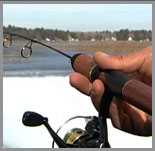
If you haven’t tried today’s micro gear, you really should. Begin with a super fast action, micro ice rod such as HT’s Polar Lites PLC-24MI, Polar Lites PLC-27LM, Polar Gold PLG-25UL or Ice Blues IB-18, IB-24, IB-30, IB-36 and IB-48. These are among the lightest, most sensitive ice fishing rods available, and combined with a lightweight, high quality spinning reel spooled with premium, micro light line of ½ - 2# test such as HT’s IBL Ice Black Line, you can fish high power tiny micro jigs in sizes #12-16 such as HT’s famous Marmooka Jigs. Tipped with a wiggler, spike, wax worm or tiny minnow, you’ll soon come to understand and reap the rewards of the micro system advantage!

TIP NO. 5: DON’T BE AFRAID TO EXPERIMENT WITH LIGHTER LINE

Modern ice anglers have a huge selection of lines to choose from, and many of these are specially engineered to help you catch more fish in specific situations.

A thick book could be written to cover them all, but to keep things as brief as possible, you can significantly increase your catch by using thinner diameter, lower memory lines. Premium, thin diameter, low memory ice lines such as HT’s IBL Ice Black Line or ARL Arctic Line provide several advantages.

First, they balance dramatically better on today’s lighter micro, finesse, ultralight and ultralight rod and reel systems, helping improve presentations with tinier ice jigs. They also cut through the water more quickly if you’re trying to lower tiny lures quickly, don’t ice up as easily and add greater sensitivity to your overall presentation. Low memory also means no “coiling,” which increases sensitivity by helping you maintain constant contact with your lure. It also stands to reason that these lines will be easier to rig whenever you’re fishing tiny, #14, #16, #18 or small micro jigs with tiny eyes--thinner diameter lines fit through thinner diameter eyelets much easier.

But don’t limit your light line usage to micro and ultralight panfish situations! For example, you’ll catch more big, finicky winter fish such as walleyes and largemouth bass by using somewhat downsized lures, and correspondingly cutting your line test down from 10# to 6# or 8# to 4#--but don’t stop there. We’ve actually been catching finicky, double-digit walleyes on Great Lakes bays in recent years using longer, 48-54” micro rods such as HT’s MM-48 or MM-54 Micromaster rods, quality spinning reels (with the drags set light) spooled with 2# test line and tipped with bare-bones jigs on dead-stick systems.

This is happening when very few fish are being taken on more traditional systems. The smaller, lighter presentations are highly effective. Just be sure to use a longer rod—the extra “sweep” helps offset mistakes because you can keep your line tight without adding pressure--simply follow the fish and lower your rod tip on hard runs. The trick is to set the hook, keep your rod tip high and the drag set light. You may even wish to consider “thumbing” a loose spool to make the reel even more forgiving. Retrieve line slowly, taking your time, and lowering the rod as necessary on runs. Maintain a tight line, but don’t apply too much pressure, always using every opportunity to gently raise the rod while slowly retrieving line.

Once the fish nears the hole, don’t try bringing it close—a short line between your rod tip and fish equals disaster when fishing light lines. Instead, keep your rod high and call for help—your partner should be able to reach down with a hand or a skimmer and guide the fish’s head into the hole. Remember, if the fish runs, lower your rod and give it line as needed until it can be lifted to the ice.

Now you’ll be experiencing the full benefits of the light line advantage!